Mushrooms for memory: which ones have real research?
Five functional mushrooms get linked to memory. Only one has direct human evidence. Here's how they rank and why the others still matter.
Mushrooms for memory, ranked by evidence
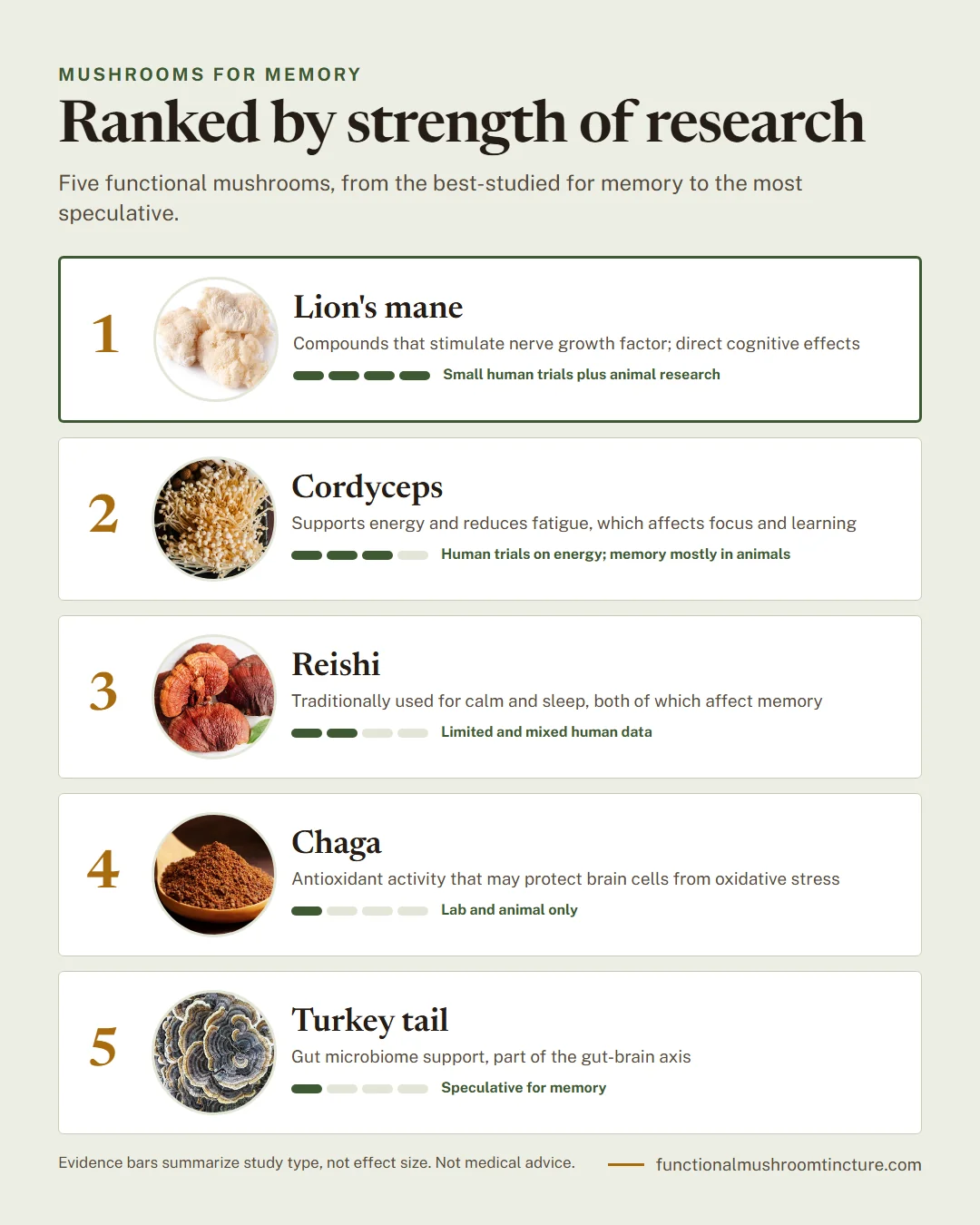
| Mushroom | How it may help memory | Strength of evidence |
|---|---|---|
| Lion's mane | Compounds that stimulate nerve growth factor; direct cognitive effects | Small human trials plus animal research |
| Cordyceps | Supports energy and reduces fatigue, which affects focus and learning | Human trials on energy; memory effects mostly in animals |
| Reishi | Traditionally used for calm and sleep, both of which affect memory | Limited and mixed human data |
| Chaga | Antioxidant activity that may protect brain cells from oxidative stress | Lab and animal only |
| Turkey tail | Gut microbiome support, part of the gut-brain axis | Speculative for memory |
1. Lion's mane: the clear leader
Lion's mane is the only functional mushroom with human trials measuring cognitive outcomes directly. In a 12-week study of healthy adults over 50, the lion's mane group improved on cognitive test scores compared with placebo. A 2023 study in younger adults found faster performance on an attention task after a single dose. The proposed mechanism involves hericenones and erinacines, which encourage nerve growth factor in lab research. Full details are in lion's mane and memory.
2. Cordyceps: memory runs on energy
Mental fatigue makes it harder to pay attention, and you can't remember what you never took in. Cordyceps has human evidence for supporting energy and exercise tolerance, and animal studies suggest possible effects on learning. It's not a memory mushroom on its own, but it pairs naturally with lion's mane. See the benefits of cordyceps mushrooms.
3. Reishi: calm and sleep
Your brain consolidates memories during sleep, and chronic stress interferes with recall. Reishi has been used for centuries as a calming tonic, and its triterpenes are studied for effects on the stress response. Human evidence is limited, so think of reishi as a supporting player.
4. Chaga: antioxidant protection
The brain uses a lot of oxygen, which makes it vulnerable to oxidative stress. Chaga shows high antioxidant activity in lab tests, and animal studies have explored effects on learning. There are no human memory trials yet.
5. Turkey tail: the gut-brain connection
The gut and brain communicate constantly, and gut bacteria produce compounds that affect mood and cognition. Turkey tail's polysaccharides have prebiotic effects in human research. A direct memory benefit hasn't been studied, but it rounds out a daily blend.
What about eating mushrooms?
Culinary mushrooms, including shiitake, oyster, and even button mushrooms, are the richest dietary source of ergothioneine, an antioxidant that researchers are studying for its role in brain aging. Eating mushrooms regularly is a good habit on its own. Supplements deliver concentrated extracts of species that are impractical to eat daily, like reishi and chaga.
A note on psilocybin
You may see "mushrooms for memory" discussed alongside microdosing psilocybin. That's a different category: psilocybin mushrooms are psychedelic and illegal in most of the US. The functional mushrooms on this page contain no psilocybin.
Memory basics mushrooms can't replace
The strongest evidence for memory support is still for sleep, regular exercise (especially aerobic), social engagement, learning new skills, and managing stress. A mushroom supplement works best on top of those, not instead of them.
Frequently asked questions
What is the best mushroom for memory?
Lion's mane has the strongest research for memory and focus, including human trials. Cordyceps and reishi may support memory indirectly through energy, stress, and sleep.
Can mushrooms improve memory?
Lion's mane has shown modest improvements on cognitive tests in small human trials. Other functional mushrooms have less direct evidence. Effects build over weeks of daily use.
Is it better to take one memory mushroom or a blend?
If memory is your only goal, lion's mane is the core ingredient. A blend adds energy, stress, and immune support in the same daily step.
Are mushrooms for memory safe?
Functional mushrooms are generally well tolerated. Check with a doctor if you're pregnant, nursing, on medication, or have a mushroom allergy.
Sources
- Saitsu Y, et al. "Improvement of cognitive functions by oral intake of Hericium erinaceus." Biomedical Research, 2019. PubMed
- Docherty S, et al. "Acute and chronic effects of lion's mane mushroom supplementation on cognitive function, stress and mood in young adults: a double-blind, parallel groups, pilot study." Nutrients, 2023. PubMed
- Brandalise F, et al. "Dietary supplementation of Hericium erinaceus increases mossy fiber-CA3 hippocampal neurotransmission and recognition memory in wild-type mice." Evidence-Based Complementary and Alternative Medicine, 2017. PubMed
- Hirsch KR, et al. "Cordyceps militaris improves tolerance to high-intensity exercise after acute and chronic supplementation." Journal of Dietary Supplements, 2017. PubMed
- Wachtel-Galor S, et al. "Ganoderma lucidum (Lingzhi or Reishi): a medicinal mushroom." In Herbal Medicine: Biomolecular and Clinical Aspects, 2nd ed., 2011. PubMed
- Pallav K, et al. "Effects of polysaccharopeptide from Trametes versicolor and amoxicillin on the gut microbiome of healthy volunteers." Gut Microbes, 2014. PubMed