Lion's mane and memory: what the human studies found
Lion's mane is the most studied mushroom for memory and focus. Here's how it may work, what the trials actually measured, and what to realistically expect.
How lion's mane may support memory
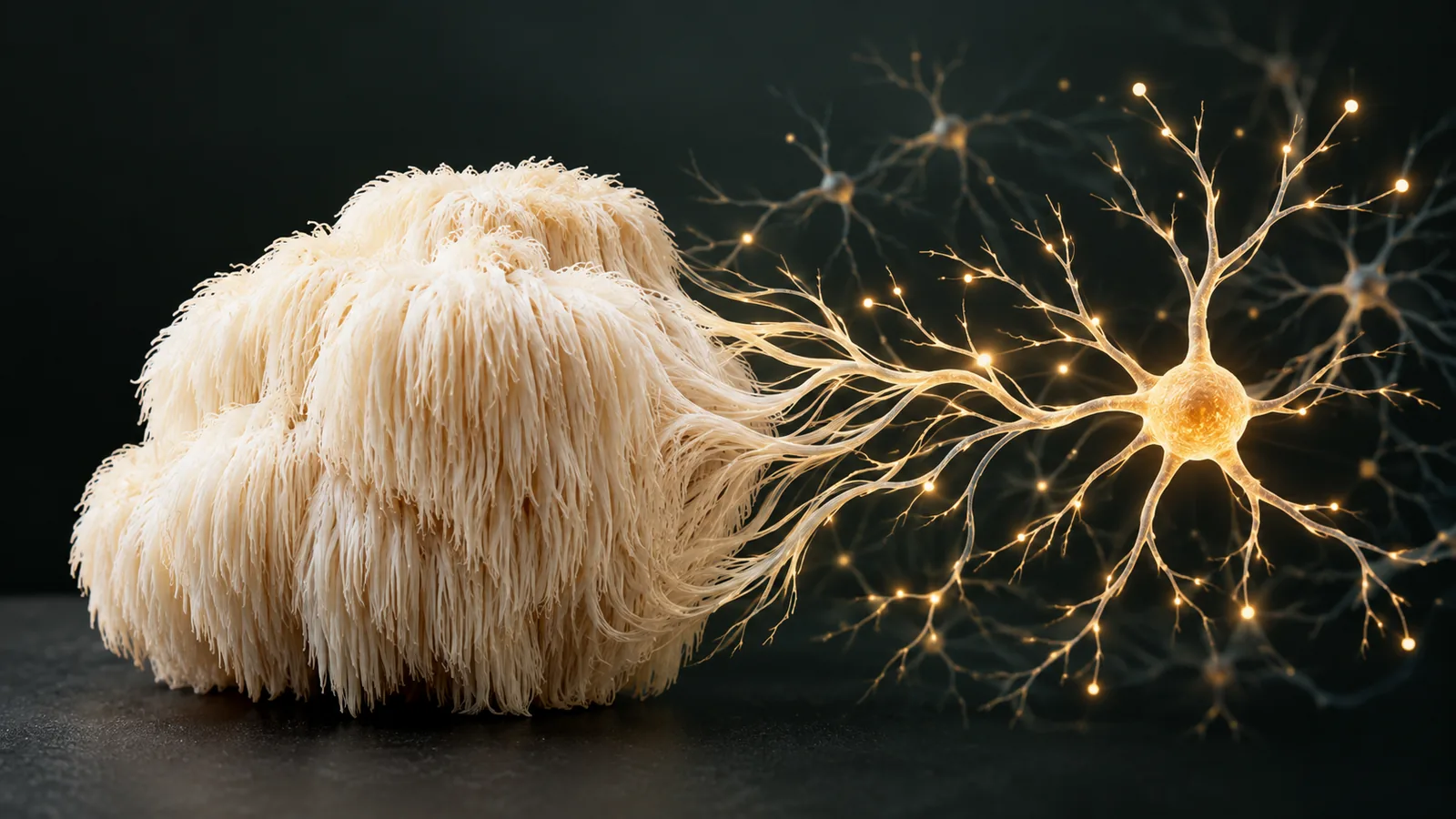
Lion's mane (Hericium erinaceus) contains two families of compounds not found in other mushrooms:
- Hericenones, found in the fruiting body.
- Erinacines, found mainly in the mycelium.
In lab and animal research, both have been shown to encourage production of nerve growth factor (NGF), a protein that helps neurons grow, maintain themselves, and form connections. Memory depends on those connections, particularly in the hippocampus, the brain's memory hub. In one mouse study, a lion's mane diet increased signaling in a hippocampal pathway involved in memory and improved performance on a recognition memory test.
Whether the same mechanism works in people at supplement doses is still being studied. The human trials measure outcomes, like test scores, rather than NGF levels directly.
What the human studies found
| Study | Who | What they took | What they found |
|---|---|---|---|
| Saitsu et al., 2019 | 31 healthy adults over 50 | Lion's mane or placebo daily for 12 weeks | Improved scores on cognitive function tests versus placebo |
| Docherty et al., 2023 | 41 healthy adults aged 18 to 45 | Single dose, then daily for 28 days | Faster performance on an attention task (Stroop) 60 minutes after one dose; a trend toward lower subjective stress after 28 days; most other measures unchanged |
Two honest caveats: both trials were small, and the benefits were measured on specific tests rather than everyday memory.
What to realistically expect
Most people who take lion's mane describe clearer thinking and easier focus rather than a sudden jump in memory. Based on the research, give it at least four weeks of daily use, and ideally twelve, before you judge it. It works best alongside the basics that affect memory most: sleep, exercise, and managing stress.
How much lion's mane?
Human studies have used a wide range, from under a gram to several grams of mushroom per day. Extracts are concentrated, so a 10:1 extract delivers the equivalent of ten times its weight in dried mushroom. Follow the label of your product and stay consistent.
Does the form matter for memory?
Hericenones come from the fruiting body and erinacines mainly from the mycelium, so both parts have a case. The bigger issue is quality. A fruiting-body extract with a stated ratio gives you a known amount of real mushroom. A mycelium product grown on grain may be mostly starch unless the brand discloses otherwise. Our fruiting body vs. mycelium section explains the difference.
A tincture is an easy way to take lion's mane daily, since you can hold it under your tongue or add it to morning coffee. See the mushroom tincture guide for how.
What about other mushrooms for memory?
Lion's mane leads the field, but reishi, cordyceps, and others may play supporting roles through sleep, stress, and energy. We compare them in mushrooms for memory.
Side effects
Lion's mane is a culinary mushroom and is well tolerated in studies. Rare reports include mild stomach discomfort or skin itching. Stop taking it if you have any sign of an allergic reaction, and check with your doctor if you're pregnant, nursing, or on medication.
Frequently asked questions
Does lion's mane improve memory?
Early research is promising. A 12-week trial in healthy adults over 50 found improved cognitive test scores versus placebo. The studies are small, so think of it as modest support rather than a guaranteed improvement.
How long does lion's mane take to work for memory?
One study found faster attention-task performance about an hour after a single dose, but memory-related improvements were measured after 12 weeks of daily use.
What is the best time to take lion's mane?
Most people take it in the morning to support focus through the day. Consistent daily use matters more than exact timing.
Is lion's mane better as a tincture or capsule?
Either can work if it's a quality extract. A tincture allows flexible dosing and no pills; capsules have no taste. Check for fruiting-body extract, an extract ratio, and a COA.
Can I take lion's mane with coffee?
Yes, and it's a popular combination. You can add a lion's mane tincture directly to your coffee.
Sources
- Saitsu Y, et al. "Improvement of cognitive functions by oral intake of Hericium erinaceus." Biomedical Research, 2019. PubMed
- Docherty S, et al. "Acute and chronic effects of lion's mane mushroom supplementation on cognitive function, stress and mood in young adults: a double-blind, parallel groups, pilot study." Nutrients, 2023. PubMed
- Li IC, et al. "Neurohealth properties of Hericium erinaceus mushrooms enriched with erinacines." Behavioural Neurology, 2018. PubMed
- Brandalise F, et al. "Dietary supplementation of Hericium erinaceus increases mossy fiber-CA3 hippocampal neurotransmission and recognition memory in wild-type mice." Evidence-Based Complementary and Alternative Medicine, 2017. PubMed