Mushroom tincture: how to use it and how to choose one
Everything you need to know before you buy a mushroom tincture, from how sublingual use works to the seven things to check on the label.
What is a mushroom tincture?
A tincture is a concentrated liquid extract. Traditional herbal tinctures soak a plant in alcohol for weeks. Mushroom tinctures work a bit differently, because the compounds in mushrooms need two kinds of extraction (see why mushrooms need to be extracted). Today you'll find three main styles:
| Style | How it's made | Good to know |
|---|---|---|
| Alcohol tincture | Mushroom soaked in grain alcohol | Pulls triterpenes well, beta-glucans poorly. Strong taste, and not for everyone who avoids alcohol. |
| Dual-extract tincture | Hot-water extract combined with an alcohol extract | Captures both compound groups. Usually still contains alcohol. |
| Extract in an oil or glycerin base | Pre-made powdered extracts suspended in MCT oil or vegetable glycerin | No alcohol burn, milder taste, and the extract ratio is set by the powdered extract used. Flow Drops is this style. |
All three count as mushroom tinctures in everyday use. What matters most is which part of the mushroom was extracted and how concentrated the extract is.
How to use a mushroom tincture
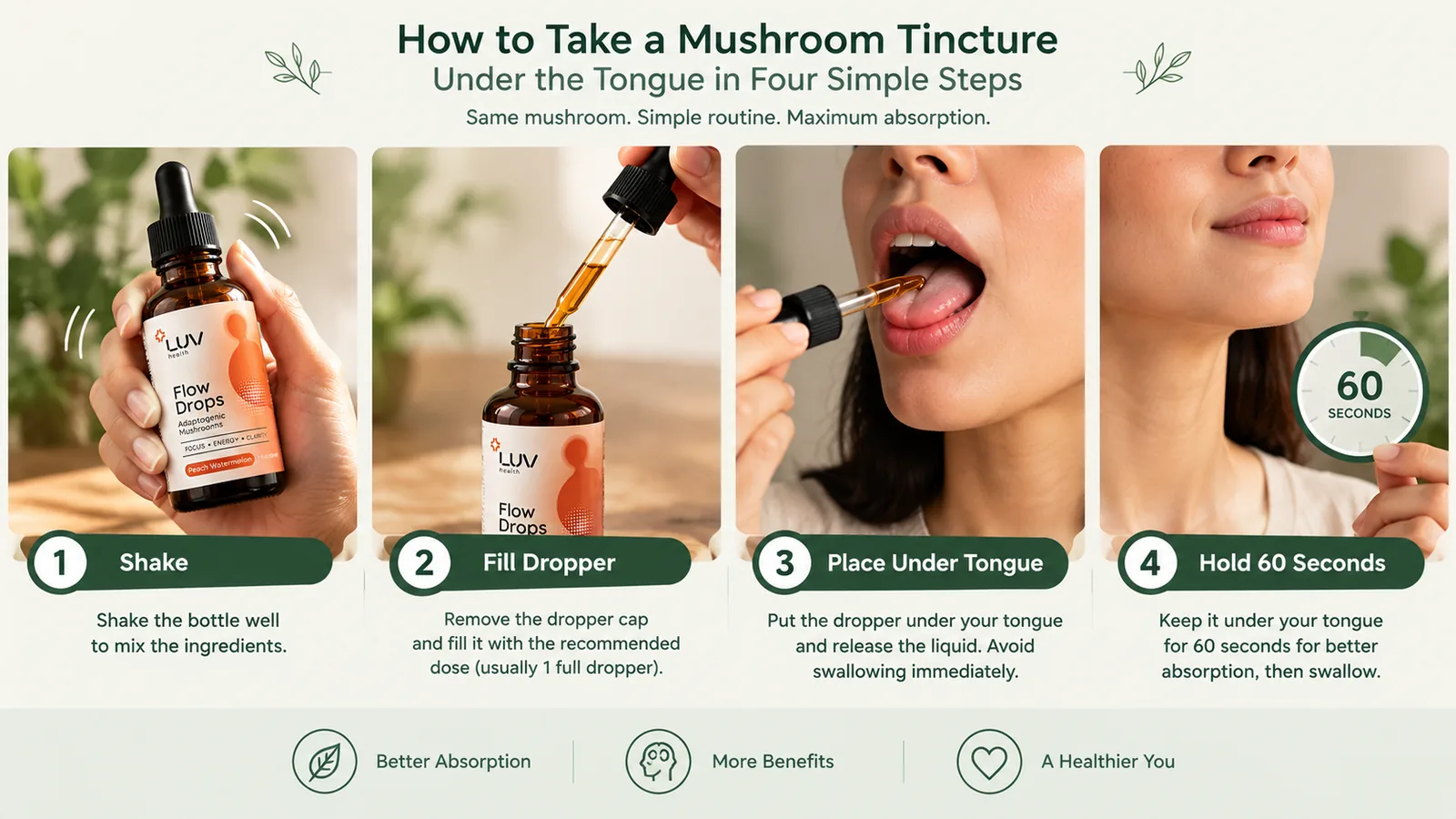
- Shake the bottle. Extract particles settle in oil-based tinctures.
- Fill the dropper to the dose on the label. For Flow Drops that's one to two full droppers a day.
- Place it under your tongue and hold for about 60 seconds before swallowing. The tissue under your tongue is thin and full of blood vessels, which is why sublingual use is popular for liquid supplements.
- Take it at the same time each day. Consistency matters more than timing.
If you don't like the feel of holding it, you can add it to water, coffee, tea, or a smoothie. Avoid adding it to boiling liquid, and stir well since oil doesn't mix into water on its own.
When to take it: morning, afternoon, or night?
Match the timing to the mushrooms and your goal:
- Morning: blends led by lion's mane and cordyceps, for focus and energy through the workday.
- Early afternoon: a second dose for the post-lunch slump, in place of a second coffee.
- Before a workout: cordyceps-containing blends, as a caffeine-free option.
- Evening: reishi-heavy formulas, which are traditionally used to wind down.
A five-mushroom blend like Flow Drops is designed for daytime. Most people take it in the morning, with an optional second dose midday.
How long does a mushroom tincture take to work?
Expect a gradual effect rather than a jolt. In the research, a single dose of lion's mane produced faster performance on one attention test within about an hour, but most measured benefits showed up after 3 to 12 weeks of daily use. Plan on a full month before you decide whether it's working for you. That's one reason a money-back guarantee is worth looking for.
Mushroom tincture vs. capsules, powder, gummies, and coffee
| Format | Pros | Cons |
|---|---|---|
| Tincture | Flexible dose, no caffeine, portable, sublingual option, no pills | Earthy taste; oil-based bottles need a shake |
| Capsules | Tasteless, easy to count | Often 2 to 4 capsules a day; many use mycelium on grain |
| Powder | Cheap per gram, mixes into drinks | Messy, hard to dose on the go, taste is strong |
| Gummies | Pleasant to take | Added sugar, low extract doses fit in a gummy |
| Mushroom coffee | Fits an existing habit | Contains caffeine; mushroom dose per cup is often small |
For a deeper comparison with label red flags, see our functional mushroom products buyer's guide.
How to choose a mushroom tincture: a label checklist
- Latin species names. "Lion's mane" is fine on the front. The supplement facts panel should say Hericium erinaceus.
- Fruiting body, stated clearly. If the label says "mycelium," "myceliated grain," or "full spectrum" with no further detail, you may be paying for oats.
- An extract ratio. Something like 8:1 or 10:1 tells you the extract is concentrated. No ratio usually means no extraction.
- Organic certification. Mushrooms absorb what they grow in, including heavy metals, so sourcing matters.
- A certificate of analysis (COA) from a third-party lab that you can actually view.
- A realistic dose. Compare mushroom equivalent per serving, not just the milliliter volume.
- No disease claims. A brand that promises to cure anything is telling you something about its other claims.
Storage and shelf life
Keep the bottle closed, out of direct sun, and at room temperature. Amber glass protects the extract from light. Most mushroom tinctures last one to two years unopened; check the date on the bottle and use an opened bottle within a few months for best flavor.
Side effects
Most people notice nothing beyond the earthy taste. Occasional reports include mild stomach upset, which usually settles if you take it with food. Oil-based tinctures with MCT oil can loosen stools if you start with a large dose, so begin with one dropper. See the safety notes for when to check with a doctor first.
Frequently asked questions
Do you put mushroom tincture under your tongue?
Yes, that's the most common way. Hold it under your tongue for about 60 seconds, then swallow. You can also mix it into a drink if you prefer.
How much mushroom tincture should I take?
Follow the label. For Flow Drops, that's one to two full droppers a day, which provides 500 mg of mushroom equivalent per serving.
Is a mushroom tincture better than capsules?
Not automatically. A tincture offers flexible dosing, no pills, and a sublingual option, but extract quality matters more than format. A fruiting-body extract in capsules beats a grain-based tincture.
Can I take a mushroom tincture with coffee?
Yes. Many people add it to their morning coffee or take it alongside. Stir it in, since oil-based tinctures don't dissolve in water on their own.
Do mushroom tinctures contain alcohol?
Traditional and dual-extract tinctures usually do. Oil-based and glycerin-based tinctures, including Flow Drops, list no alcohol.
Sources
- Docherty S, et al. "Acute and chronic effects of lion's mane mushroom supplementation on cognitive function, stress and mood in young adults: a double-blind, parallel groups, pilot study." Nutrients, 2023. PubMed
- Saitsu Y, et al. "Improvement of cognitive functions by oral intake of Hericium erinaceus." Biomedical Research, 2019. PubMed
- Wachtel-Galor S, et al. "Ganoderma lucidum (Lingzhi or Reishi): a medicinal mushroom." In Herbal Medicine: Biomolecular and Clinical Aspects, 2nd ed., 2011. PubMed