Functional mushroom products: an honest buyer's guide
Tinctures, capsules, gummies, powders, and mushroom coffee compared, plus the label red flags that separate real extracts from filler.
Types of functional mushroom products
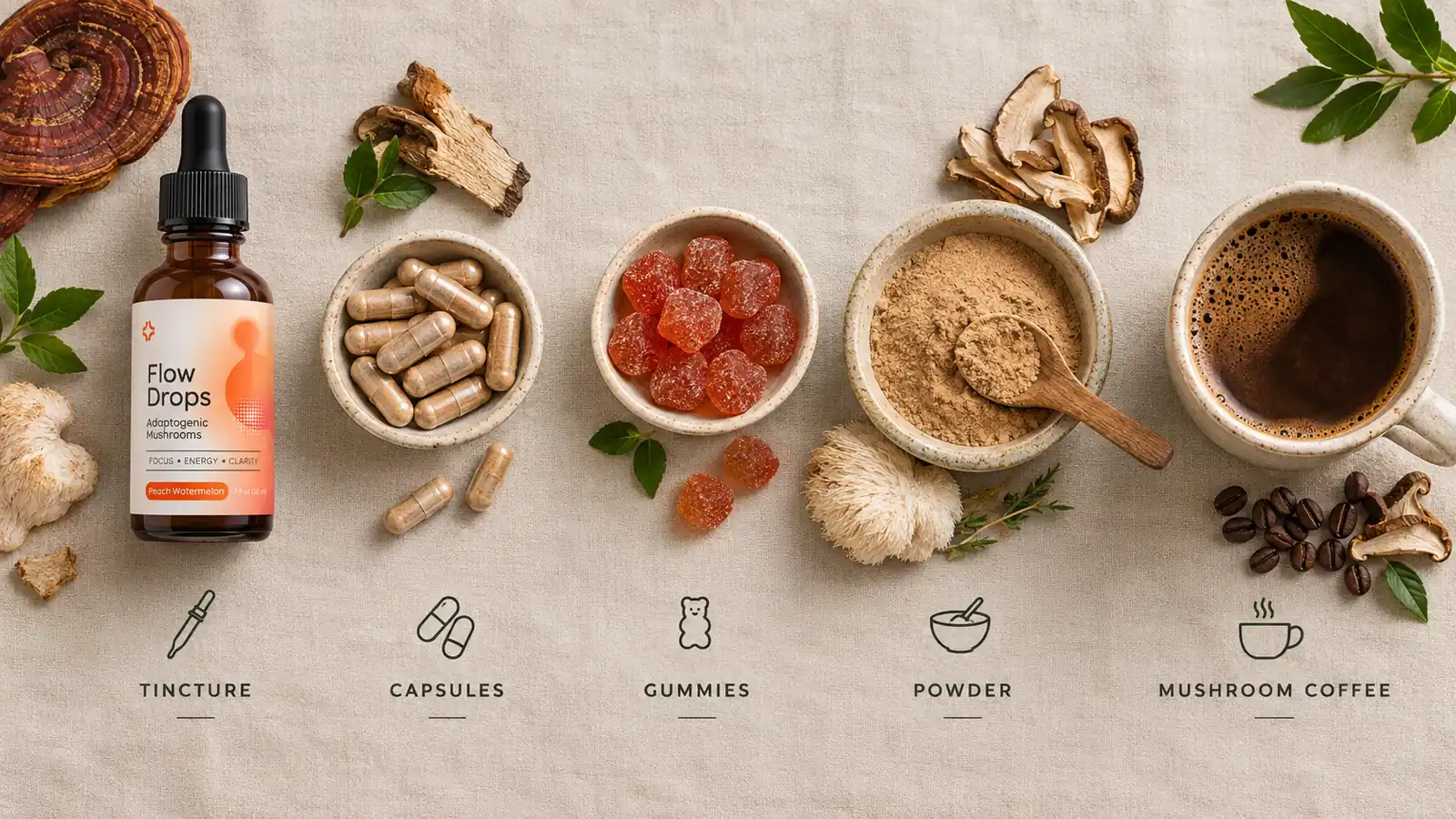
The category has exploded, and product formats now range from supplements to snacks. Here's what each one is best at.
| Product | Best for | Watch out for |
|---|---|---|
| Tinctures and drops | Daily use, flexible dosing, taking on the go, avoiding caffeine | Tinctures with no extract ratio listed |
| Capsules | People who want no taste | Myceliated grain fillers; high capsule counts per serving |
| Powders | Smoothie and coffee mixers, lowest price per gram | Unextracted raw powder, which releases little through chitin |
| Gummies | People who hate taking supplements | Sugar, and small doses because only so much fits in a gummy |
| Mushroom coffee and cacao | Swapping into an existing ritual | Caffeine, and a mushroom dose per cup that's often a fraction of a supplement serving |
| Snacks, chocolate, drinks | Novelty | Doses rarely disclosed |
Red flags on a functional mushroom label
- "Mycelium" or "myceliated grain" as the main ingredient without a disclosed grain content or active compound level.
- "Full spectrum" with no extract ratio. This often means the whole grain-and-mycelium block, dried and ground.
- Common names only. No Latin names suggests the brand isn't specific about species or strain.
- Proprietary blends with a tiny total. Ten mushrooms in 300 mg is 30 mg each at best.
- Disease claims. Supplements can't legally claim to treat or prevent disease. Brands that do are cutting corners.
- No certificate of analysis. Mushrooms can accumulate heavy metals from their growing medium, so testing matters.
Single mushroom or blend?
A single-species product makes sense when you have one clear goal and want a higher dose of that mushroom, for example lion's mane alone for a focus experiment. A blend makes sense when you want broad daily support and don't want to buy, dose, and track five bottles. Because the core five mushrooms work on different systems (focus, energy, stress, antioxidant, immune), blends are the most popular choice for everyday use.
Our pick: Flow Drops
We make Flow Drops, so weigh this section accordingly. Here's how it stacks up against the checklist above:
| Checklist item | Flow Drops |
|---|---|
| Species | Hericium erinaceus, Cordyceps militaris, Ganoderma lucidum, Inonotus obliquus, Trametes versicolor |
| Part used | Fruiting body only, not mycelium on grain |
| Extract ratio | 10:1 for each mushroom |
| Dose | 500 mg mushroom equivalent per serving; 1 to 2 droppers daily |
| Organic | USDA Certified Organic mushrooms |
| Testing | Third-party lab tested; COA published on the product page |
| Base | MCT oil, stevia, natural flavors. No alcohol, sugar, gluten, or soy. Vegan and keto-friendly. Contains coconut. |
| Made in | USA, cGMP facility |
| Customer rating | 4.7 out of 5 from 1,153 reviews on luv.health (81% five-star) |
| Guarantee | 100% money back, even if the bottles are empty |
Who it's a good fit for: people who want focus, steady energy, and stress and immune support from one daily product, without caffeine or pills.
Who might want something else: anyone avoiding stevia or coconut, anyone who wants a high single-species dose, and anyone who prefers an evening-only reishi product.
What functional mushroom products cost
Quality tinctures and capsules typically run $30 to $70 per month's supply at single-bottle prices, with multi-packs and subscriptions bringing that down. Flow Drops is $49 for one bottle or $129 for three on luv.health at the time of writing. Very cheap products are usually cheap for a reason, most often grain-based mycelium or low doses.
How to judge whether a product is working
Pick one or two things you want to change, like afternoon energy or how long you can focus on hard work. Note where you are now, take the product daily for four weeks, then compare. Change one thing at a time so you know what made the difference.
Frequently asked questions
What is the best functional mushroom product?
The best product is one you'll take every day that uses fruiting-body extracts, lists Latin species names and an extract ratio, and publishes a third-party COA. We make Flow Drops, a five-mushroom tincture that meets those criteria.
Are mushroom gummies as good as tinctures?
Usually not on dose. A gummy can only hold so much extract, and many add sugar. A tincture or capsule typically delivers more mushroom per serving.
Is mushroom coffee a functional mushroom product?
Yes, but the mushroom dose per cup is often small, and it still contains caffeine. It's best thought of as a coffee swap rather than a supplement.
Are functional mushroom products regulated?
In the US they're sold as dietary supplements or foods. The FDA doesn't approve supplements before sale, which is why third-party testing and clear labels matter.